



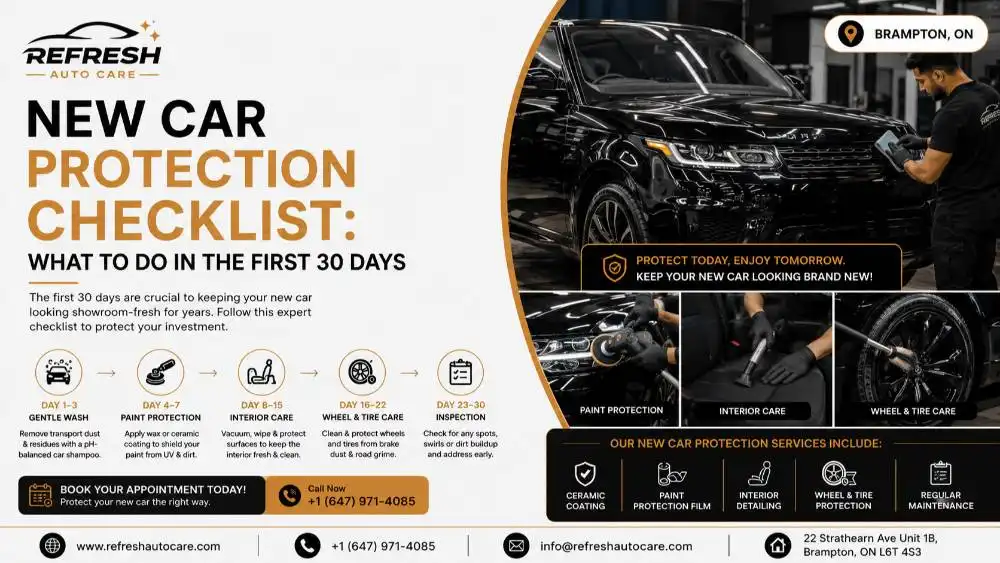
New Car Protection Checklist: What to Do in the First 30 Days
14-Sep-2026
The best first 30-day new-car protection plan is to inspect and document the vehicle, wash it safely, identify any dealer-applied protection, assess the paint, then choose PPF, ceramic coating, detailing or a combination based on how you drive. PPF is primarily for stone chips and road debris, while ceramic coating improves hydrophobicity, chemical resistance, gloss and ease of maintenance. In Brampton, winter salt, gravel and highway driving can make front-end PPF particularly useful.
Why Trust This Guide?
| Trust Signal | Details |
|---|---|
| Updated for 2026 | Latest paint protection technologies and practices |
| Industry Research | References to 3M product specifications and guidelines |
| Technical Expertise | Based on professional PPF, ceramic coating, and detailing practices |
| Local Market Focus | Brampton, Ontario, and GTA driving conditions |
| Actionable Insights | Checklists, decision guides, and practical timelines |
This guide is based on industry research, technical expertise, and practical experience in professional paint protection.
Last Reviewed: July 2026
Key Takeaways
- PPF protects against physical impact such as stone chips and road debris.
- Ceramic coating improves hydrophobicity, gloss and ease of maintenance but isn't a substitute for PPF.
- A new car does not automatically require paint correction; inspect the paint first.
- Check for dealer-applied wax, sealant or coating before installing additional protection.
- PPF is generally installed before a compatible ceramic coating when both are being used.
- Brampton and GTA driving conditions can increase exposure to salt, gravel and road debris.
- Always follow the specific manufacturer's installation and aftercare requirements.
30-Second Protection Decision Guide
| If you mainly want... | Consider... |
|---|---|
| Protection from stone chips | PPF |
| Easier washing | Ceramic Coating |
| Gloss + hydrophobicity | Ceramic Coating |
| Front-end impact protection | PPF |
| Both physical and surface protection | PPF + compatible ceramic coating |
| Cabin heat and glare reduction | Window Tint |
| Removal of swirls or defects | Paint Correction |
30-Day New Car Protection Checklist
| Time | What to Do | Why It Matters |
|---|---|---|
| Days 1–3 | Inspect and photograph the vehicle | Establish the vehicle's condition |
| Days 1–7 | Wash and safely decontaminate | Remove road and dealer contamination |
| Days 1–14 | Identify existing protection | Avoid compatibility issues |
| Days 1–14 | Compare PPF and ceramic coating | Match protection to your needs |
| Before installation | Inspect and prepare the paint | Address contamination or defects |
| Installation | Apply selected protection | Protect vulnerable surfaces |
| First 3–7 days | Follow curing instructions | Protect the installation |
| First 30 days | Establish maintenance habits | Reduce avoidable surface damage |
Why the First 30 Days Matter
A new vehicle does not need to wait 30 days for its factory paint to "cure." The first 30 days are simply a useful ownership window for inspecting the vehicle, correcting delivery-related defects, identifying dealer-applied protection and choosing a suitable protection system before significant road exposure accumulates.
A new vehicle may have limited road exposure, but transport, storage and dealer preparation can still leave contamination or surface defects. Taking proactive steps during this window can:
- Preserve your vehicle's appearance
- Reduce the amount of corrective maintenance your vehicle may require
- Keep your car looking newer for longer
- Prevent permanent damage from environmental factors
It also gives owners an opportunity to identify dealer-installed products before adding another protection system.
The correct workflow depends on whether you're doing PPF only, ceramic coating only, PPF plus ceramic coating, or addressing dealer-installed protection. A typical paint-protection workflow is inspection → cleaning/decontamination → paint correction when required → PPF installation where selected → ceramic coating where compatible → final inspection. The exact sequence should be determined by the installer and the products being used.
New Car Delivered by a Dealership: What Should You Check?
Before booking any protection, inspect and document:
- Paint condition
- Wheels
- Glass
- Trim
- Interior
- Factory protective film
- Dealer-applied wax, sealant or coating
- Delivery scratches
- Swirl marks
- Paint contamination
- Documentation of installed protection
Do not authorize additional coating or PPF until you know what products have already been applied.
Days 1–3: Inspect and Wash
The first thing you should do is give your car a proper wash—but not just any wash. Avoid automated car washes with harsh brushes that can create swirl marks. Instead:
- If washing by hand, a two-bucket method can help reduce the chance of transferring abrasive contamination back onto the paint.
- Use a pH-balanced automotive shampoo rather than household detergents or cleaners.
- Avoid abrasive brushes, chemicals, or cleaners that may scratch the finish.
- Dry with a microfiber towel to prevent water spots.
Then inspect your car's paint in good lighting. Look for:
- Any transport-related imperfections
- Minor scratches from delivery or dealer preparation
- Areas that might need extra protection
A new car does not automatically need paint correction or a full detailing service. The correct preparation depends on the vehicle's actual condition.
If contamination or delivery-related marks are present, professional car detailing in Brampton can help prepare the surface before protection is installed.
Days 4–7: Document Condition
Photograph existing defects and create a condition record. This serves two purposes:
- It documents the vehicle's condition at delivery
- It helps you track any changes over time
Take photos of:
- The full exterior from multiple angles
- Close-ups of any visible imperfections
- The interior condition
This documentation can be valuable if you need to file a warranty claim or if you decide to sell the vehicle later.
Days 8–14: Choose Protection
This is where you need to decide between the two main paint protection options:
| Feature | Paint Protection Film (PPF) | Ceramic Coating |
|---|---|---|
| Primary benefit | Physical protection from stone chips and road debris | Hydrophobicity, chemical resistance and easier maintenance |
| Physical impact protection | Strong | Limited |
| Hydrophobic behaviour | Depends on film | Yes |
| Environmental exposure | Can help protect underlying finish | Can provide additional surface protection |
| Scratch resistance | Helps against certain minor surface damage | Limited; not scratch-proof |
| Best suited for | High-impact areas | Broader painted surfaces and easier maintenance |
Some vehicle owners choose to combine PPF with a compatible ceramic coating to add hydrophobicity, gloss and easier maintenance over protected areas.
Paint Protection Film
Paint Protection Film is designed to reduce paint damage from stone chips, road debris, bug impacts and minor surface abrasion. It is a sacrificial layer and does not make paint completely damage-proof. It's especially useful for areas prone to damage, like the front profile or wheel arches.
3M offers several automotive PPF systems designed for protection against stone chips, scratches, bug damage, road tar and other environmental exposure. Film construction and warranty terms vary by product. For example, according to 3M's published product information, the 3M™ Scotchgard™ Paint Protection Film Pro Series 200 carries a 10-year consumer warranty, subject to the applicable warranty terms and installation requirements. 3M Paint Protection Film provides more information about their product offerings.
Learn more about paint protection film in Brampton options available at Refresh Auto Care.
Ceramic Coating
Ceramic coating is a liquid polymer applied to a vehicle's exterior. The primary ingredient is silicon dioxide (SiO₂). Once cured, a professional ceramic coating creates a bonded protective layer that can improve water behaviour, chemical resistance, gloss and ease of maintenance.
Professional ceramic coating durability varies significantly by coating system, preparation, installation, environmental exposure and maintenance. Always check the specific manufacturer's warranty and maintenance requirements rather than assuming a universal lifespan.
For professional ceramic coating in Brampton, proper installation ensures optimal results and longevity.
Days 15–21: Professional Inspection, Preparation and Installation
The exact timing does not need to follow a fixed calendar. The important step is to have the vehicle inspected and properly prepared before PPF or ceramic coating is installed. Before installation, the vehicle should be inspected because new-car paint can still have transport marks, dealer-installed swirls or surface contamination.
What a Professional Inspection Should Check
A professional inspection should assess:
- Paint condition
- Transport marks
- Dealer-installed swirls
- Paint contamination
- Existing wax, sealant or coating
- Factory protective film
- Glass condition
- Trim condition
- High-impact areas
- Paint-correction requirements
- PPF coverage requirements
- Coating compatibility
If you're in the Brampton area, consider professional services from Refresh Auto Care, a provider of auto detailing, ceramic coating, and PPF in Brampton.
Before Booking PPF: What to Confirm
- Confirm the exact film brand and product — Ask for product name and specifications
- Ask whether the film is model-pattern cut — Pre-cut patterns vs custom cutting
- Confirm coverage areas — Full-front, partial, full-body or custom coverage
- Ask how paint preparation is handled — Decontamination and correction process
- Confirm applicable manufacturer warranty — Product warranty period and terms
- Ask about edge wrapping where appropriate — Wrapped edges vs exposed edges
- Ask about post-installation washing restrictions — Curing time and wash guidelines
- Confirm aftercare requirements — Maintenance needed to keep warranty valid
- Ask whether the installer uses a computer-cut pattern or performs custom trimming — This affects fit and coverage precision
For Paint Protection Film:
- Ask about full-front coverage (hood, bumper, fenders, mirrors)
- Consider additional coverage for rocker panels and door edges
- Ask for the exact film name, manufacturer, warranty terms and technical specifications rather than relying only on phrases such as "premium PPF" or "high-quality film"
- Confirm the specific warranty period for the film being installed
For Ceramic Coating:
- Surface preparation is critical—ensure proper decontamination and polishing before application
- Ask about the specific product being used and its durability
- Understand the curing time and aftercare requirements
Days 22–30: Start the Maintenance Routine
The final week is about building habits that will protect your investment long-term.
Washing Best Practices:
- Rinse your vehicle frequently with water
- Use a pH-balanced automotive shampoo rather than household detergents or cleaners
- Never use anything abrasive on your vehicle
- Avoid washing in direct sunlight to minimize streaking and water spotting
- If washing by hand, a two-bucket method can help reduce the chance of transferring abrasive contamination back onto the paint
Parking Habits:
- Park in shaded areas when possible to reduce UV exposure
- Avoid parking under trees that drop sap or bird droppings
- If using a car cover outdoors, choose a properly fitted cover designed for automotive finishes and use it only on a clean, dry vehicle
Daily Checks:
- Bird droppings, bug residue and some other contaminants can etch or stain automotive finishes if they remain on the surface, particularly in heat. Remove them as soon as practical.
- Check for any new chips or scratches
- Keep appropriate automotive cleaning supplies available so contaminants can be removed safely as soon as practical
PPF vs Ceramic Coating: Which Should You Choose?
| Your Priority | Best Fit |
|---|---|
| Stone chips from highway driving | PPF |
| Road debris and gravel | PPF |
| Front-end impact protection | PPF |
| Easier washing and cleaning | Ceramic Coating |
| Hydrophobicity and gloss | Ceramic Coating |
| Chemical contamination (bird droppings, tree sap) | Ceramic Coating |
| Broader combined protection | PPF + Ceramic Coating |
| Cabin heat and glare | Window Tint |
| Interior UV exposure | Window Tint |
| Paint swirl marks removal | Paint Correction |
What should you protect first on a new car?
Start with the areas most exposed to damage and the protection that matches your driving conditions. For many drivers, that means PPF on high-impact areas such as the front bumper, hood, fenders, mirror caps and rocker panels. Ceramic coating can then be considered for broader paint-surface protection and easier maintenance. Window tint addresses cabin heat, glare and UV exposure rather than paint protection.
Should You Get PPF and Ceramic Coating Together?
Can you put ceramic coating over PPF?
Yes, a compatible ceramic coating can be applied over PPF after the film has been properly installed and prepared. This combination allows PPF to provide physical impact protection while the coating adds hydrophobicity, gloss and additional surface protection.
If an existing ceramic coating is present, do not assume that PPF can be installed directly over it. 3M states that PPF should not be installed over an existing ceramic coating—the ceramic coating must be professionally removed before installing PPF for proper adhesion and long-term durability. After the PPF is installed, you can apply 3M™ Ceramic Coating on top to enhance gloss, hydrophobicity, and ease of maintenance. Product compatibility and installation timing should always be confirmed with the installer.
Should I get PPF or ceramic coating first?
If you want both PPF and ceramic coating, PPF is generally installed first on the selected painted areas, followed by a compatible ceramic coating when recommended by the manufacturer and installer. The exact process depends on the products being used and the condition of the vehicle.
What Areas of a New Car Should Get PPF?
For most drivers, the highest-impact areas include:
- Front bumper — Most vulnerable to stone chips
- Hood — Large flat surface exposed to debris
- Fenders — Side areas catching kicked-up rocks
- Mirror caps — Often protruding and vulnerable
- Rocker panels — Low areas catching gravel from wheels
Some owners also choose additional coverage for:
- Door edges and door handle recesses
- Rear bumper ledge (loading/unloading area)
- A-pillars and roof leading edge
The right coverage depends on your driving patterns, parking conditions and how much of the vehicle you want to protect. A professional installer can recommend a customized PPF package for your vehicle.
Does a New Car Need Paint Correction Before Protection?
Professional Inspection Tip
Before applying PPF or ceramic coating to a new vehicle, inspect the paint under controlled lighting rather than assuming factory-new means defect-free. Transport marks, dealer washing, contamination and minor surface defects can affect the preparation process. A professional installer should assess the paint before recommending correction or protection.
While a brand-new car shouldn't need major paint correction, minor imperfections are common:
- Transport-related scratches from delivery
- Dealer-installed swirl marks from improper washing
- Factory paint characteristics or imperfections such as dust nibs and excessive orange peel
Paint correction may be beneficial even on new vehicles to ensure the best possible surface for protection application. Some professional detailers offer light correction services specifically for new cars to address these common issues. Ask your installer about paint correction in Brampton if you notice imperfections.
What If the Dealer Already Applied Wax or Coating?
Before booking PPF or ceramic coating, ask the dealership exactly what was applied to the vehicle. Dealer-applied waxes, sealants, coatings or other protection products may need to be removed during professional preparation. Do not assume a new vehicle is ready for immediate coating simply because it looks clean.
What if your new car has existing paint protection?
Identify the product before installing another system:
- Dealer-applied wax — Usually temporary and may need removal
- Dealer sealant — May interfere with PPF or ceramic bonding
- Dealer ceramic coating — Product quality varies; compatibility with new coatings should be verified
- Factory protective film — Typically on specific areas; may complement PPF
- Unknown protection — Ask the dealer for documentation before scheduling professional work
How to Choose a PPF or Ceramic Coating Installer in Brampton
When evaluating professional installers, consider these factors:
- Experience and Training — Look for installers with documented training from product manufacturers
- Product Quality — Ask which specific films or coatings they use and verify manufacturer warranties
- Installation Environment — Professional installations require clean, controlled environments
- Preparation Process — Ask about their decontamination and paint correction procedures
- Warranty — Review manufacturer and installer warranties
- Reviews and Portfolio — Check previous work and customer feedback
For Brampton residents, Refresh Auto Care provides professional PPF, ceramic coating, detailing, paint correction and window tinting services, allowing several protection needs to be assessed through one provider.
What to Check Before Booking:
- Confirm product selection — Know exactly which film or coating will be used
- Review warranty terms — Understand what's covered and what maintenance is required
- Ask about prep requirements — Some coatings require specific surface preparation
- Check curing time — Understand when the vehicle can be driven and washed
- Schedule appropriately — Allow enough time for proper application and curing
New Car Protection Mistakes to Avoid
- Using Automated Car Washes — Brush-based automatic washes can increase the risk of wash-induced marring, especially when brushes or equipment carry abrasive contamination. Touchless washes reduce physical contact with the paint, but some systems use stronger cleaning chemicals than a carefully controlled hand wash.
- Assuming Protection Is Already Applied — Many dealerships apply sealants or waxes, but these are temporary and not comparable to professional PPF or ceramic coating.
- Neglecting Bird Droppings and Tree Sap — Bird droppings, bug residue and some other contaminants can etch or stain automotive finishes if they remain on the surface, particularly in heat. Remove them as soon as practical.
- Skipping Professional Preparation — Proper surface preparation—decontamination and paint correction—is essential for protection to bond correctly.
- Using the Wrong Cleaning Products — Avoid dish soap, household cleaners, or any abrasive products. Use only automotive-specific products.
- Applying Wax Over Ceramic Coating — Some waxes can reduce the hydrophobic properties of ceramic coatings. Follow manufacturer guidelines.
- Washing Too Soon After Installation — Follow the film manufacturer's specified post-installation wash period. For example, 3M's published guidance recommends waiting at least 72 hours before hand washing and avoiding spray washing for the first 7 days. Requirements can vary by film and installation, so follow the instructions provided for the specific product installed.
Brampton Driving Considerations
Brampton and the wider GTA expose vehicles to seasonal road conditions that can influence paint-protection decisions:
- Winter road salt — Can accelerate corrosion on exposed or vulnerable vehicle components, making regular cleaning and proper corrosion protection important
- Gravel and sand — Used on winter roads, creates stone chip risk
- Highway driving — Frequent highway use increases exposure to debris
- Seasonal temperature changes — Can affect paint and protection longevity
- Urban contaminants — Bird droppings, tree sap and industrial fallout
Why is new-car paint protection useful in Brampton?
Brampton drivers can encounter winter road salt, gravel, slush, highway debris, bugs, tree sap and other seasonal contaminants. These conditions make physical protection such as PPF particularly relevant for high-impact painted areas, while ceramic coating can make routine cleaning and contamination removal easier.
PPF can reduce paint damage from road debris, but it is not a substitute for underbody or mechanical corrosion protection. Ceramic coating can make the painted surface easier to clean and provide resistance to certain environmental and chemical contaminants, but it does not replace regular washing or corrosion protection.
For additional UV protection and cabin comfort, window tinting in Brampton services can complement paint protection.
How to Maintain PPF and Ceramic Coating
For PPF:
- Wash regularly using pH-neutral automotive shampoo and the two-bucket method
- Follow the specific aftercare instructions supplied for the film installed on your vehicle
- Follow the film manufacturer's specified post-installation wash period
- Avoid high-pressure spray at film edges
- Remove contaminants like bird droppings promptly
- Apply manufacturer-recommended sealants if applicable
- Have the film inspected annually
For Ceramic Coating:
- Use pH-neutral automotive shampoo for regular washing
- Avoid abrasive cleaners or brushes
- Consider annual maintenance to maintain hydrophobic properties
- Avoid automatic car washes with harsh chemicals
- Follow manufacturer aftercare guidelines
For Both:
- The two-bucket wash method is recommended
- Microfiber towels and wash mitts are safest
- Use a clean, suitable drying towel and minimize unnecessary rubbing or pressure
- Annual professional inspection helps catch issues early
PPF + Ceramic Coating + Window Tint: When Does a Combined Protection Package Make Sense?
A combined protection package with PPF, ceramic coating and window tinting makes sense when:
- You plan to keep the vehicle long-term — Broader protection for years of ownership
- You frequently drive on highways — Higher risk of stone chips and debris
- You want multiple layers of protection — PPF for physical impact exposure, ceramic coating for surface and maintenance benefits, and window tint for cabin comfort and UV-related considerations
- You value convenience — One provider handling multiple services
- You want to maintain pristine condition — Easier cleaning and reduced maintenance
A typical combined package includes:
- PPF on high-impact areas (front bumper, hood, fenders, mirrors)
- Ceramic coating on all painted surfaces
- Window tinting for UV protection and heat rejection
Some providers coordinate PPF, ceramic coating and window tinting through vehicle-protection packages, allowing the services to be planned around the vehicle's condition and the owner's priorities. Explore vehicle protection packages in Brampton to compare options based on your vehicle and driving needs.
Refresh Auto Care in Brampton can assess your vehicle and recommend a customized protection package.
Why Choose Refresh Auto Care in Brampton?
Refresh Auto Care is a professional detailing and vehicle-protection studio based in Brampton, specializing in ceramic coating, paint protection film, vinyl wraps and paint correction services. Located at 22 Strathearn Ave Unit 11B, Brampton, ON, they serve customers across the GTA including Mississauga and Etobicoke.
Refresh Auto Care has served Brampton since 2014. They offer PPF, ceramic coating, detailing and paint correction services in Brampton. Product selection, preparation and aftercare should be matched to the vehicle and the manufacturer's requirements. Refresh Auto Care also offers System X Professional Grade Coatings; customers should confirm the specific coating, warranty and maintenance requirements for their vehicle.
For answers about PPF, ceramic coating, detailing and aftercare, visit Refresh Auto Care's vehicle protection FAQs. Contact them through their contact page for more information about their services and warranty coverage.
Frequently Asked Questions
1. What should I do to protect a new car in the first 30 days?
Inspect and photograph the vehicle, identify any existing protection, choose PPF, ceramic coating or both based on your driving needs, have the paint professionally prepared if necessary, and follow the installer's aftercare instructions.
2. Do I need to wait 30 days before getting PPF or ceramic coating on a new car?
No. There is generally no need to wait 30 days simply because the vehicle is new. The important step is to inspect and properly prepare the vehicle before protection is installed. The timing should be based on the vehicle's condition, any existing dealer-applied products and the requirements of the PPF or coating manufacturer.
3. Should I get PPF or ceramic coating first?
If you want both PPF and ceramic coating, PPF is generally installed first on the selected painted areas, followed by a compatible ceramic coating when recommended by the manufacturer and installer. The exact process depends on the products being used and the condition of the vehicle.
4. Can ceramic coating be applied over PPF?
Yes, a compatible ceramic coating can be applied over PPF after the film has been properly installed and prepared. This combination allows PPF to provide physical impact protection while the coating adds hydrophobicity, gloss and additional surface protection. 3M states that you may have 3M Ceramic Coating applied on top of 3M Paint Protection Film.
5. Is PPF or ceramic coating better for a new car?
It depends on what you want to protect. PPF is better suited to physical impact protection from stone chips and road debris, particularly on the front end. Ceramic coating is better suited to hydrophobicity, chemical resistance, gloss and easier maintenance. Some owners combine both, using PPF on high-impact areas and a compatible ceramic coating on the vehicle's paint.
6. Does a new car need paint correction?
While brand-new cars shouldn't require major correction, minor imperfections from transport, dealer preparation or factory defects are common. Paint correction may be beneficial to ensure the best surface for protection application. A professional inspection can determine what's needed.
7. Should I detail a new car before PPF?
Professional preparation typically includes cleaning and decontamination, while paint correction is performed only when the vehicle's condition requires it. This ensures the protection bonds properly and the best possible result is achieved.
8. What if the dealer already applied wax or coating?
Before booking PPF or ceramic coating, ask the dealership exactly what was applied. Dealer-applied waxes, sealants or coatings may need to be removed during professional preparation. Do not assume a new vehicle is ready for immediate coating simply because it looks clean.
9. What areas of a new car should get PPF?
The most vulnerable areas include the front bumper, hood, fenders, mirror caps and rocker panels. Some owners also protect door edges, rear bumper ledges and A-pillars. Coverage depends on driving patterns, road conditions, parking conditions and how much of the vehicle you want to protect.
10. How long does PPF last?
The service life of PPF depends on the film, installation quality, exposure and maintenance. Some premium films carry manufacturer warranties of up to 10 years, but the applicable warranty should be confirmed for the exact film installed.
11. How long does ceramic coating last?
Professional ceramic coating durability varies significantly by coating system, preparation, installation, environmental exposure and maintenance. Always check the specific manufacturer's warranty and maintenance requirements rather than assuming a universal lifespan.
12. Is ceramic coating scratch-proof?
Ceramic coating can improve resistance to chemical contamination, UV exposure and washing-related surface wear, but it does not provide the physical impact protection of PPF. It is not scratch-proof and should not be relied upon to prevent stone chips.
13. How do I maintain PPF and ceramic coating?
Wash regularly with pH-neutral automotive shampoo and the two-bucket method. Avoid abrasive cleaners and automatic car washes with harsh chemicals. Remove contaminants promptly. Follow manufacturer aftercare instructions and schedule annual professional inspection.
Conclusion
The best time to plan new-car protection is before normal road exposure creates avoidable wear. Start with an inspection, decide whether your priorities are stone-chip protection, easier maintenance, cabin comfort or a combination of these, and choose products based on manufacturer specifications and installer expertise.
Not sure which protection your new car needs? A professional inspection can help identify the protection that matches your driving conditions.
Have a new vehicle in Brampton? Ask Refresh Auto Care to assess the paint, existing protection and high-impact areas before installation.
Protect your new vehicle before everyday road exposure becomes avoidable paint damage. Explore vehicle protection packages or book a vehicle assessment with Refresh Auto Care in Brampton.