



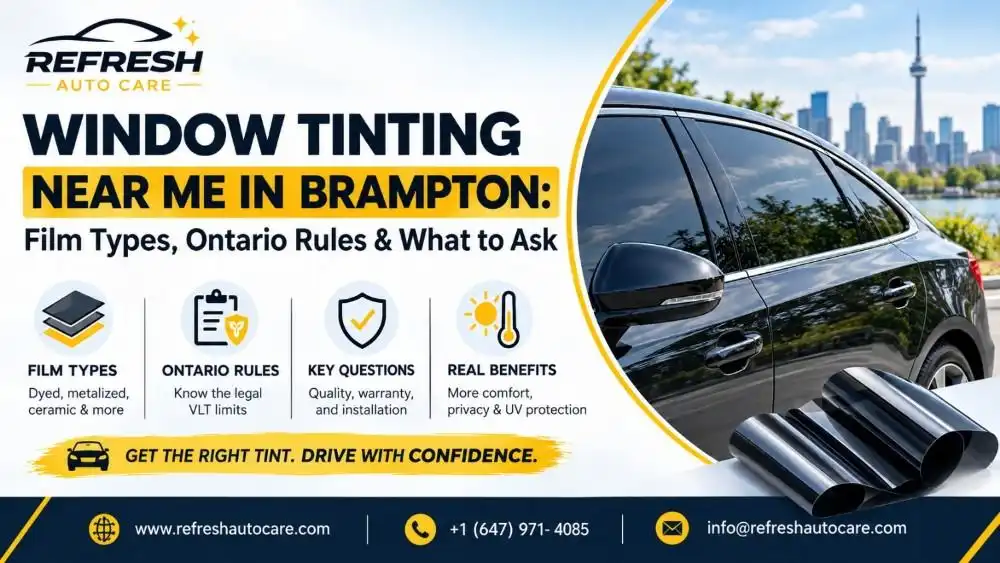
Window Tinting Near Me in Brampton: Film Types, Ontario Rules & What to Ask
28-Oct-2026
Window tinting is the professional application of a thin film to a vehicle's windows to reduce heat, block UV rays, reduce glare, and add privacy. The type of film you choose affects heat rejection, clarity, appearance, and cost.
What should I look for in window tinting near me?
Look for an installer who explains film options clearly, provides published film specifications, discusses Ontario tint requirements, offers a warranty, and has consistent, recent customer reviews.
Is ceramic window tint worth it?
Ceramic film is generally positioned as a higher-performance option for heat rejection, UV protection, and signal-safe clarity. Whether it is worth it depends on your priorities, budget, and how much sun exposure your vehicle gets.
Why Trust This Guide?
| Trust Signal | Details |
|---|---|
| Updated for 2026 | Current film technologies and installation practices |
| Local Expertise | Based on Brampton & GTA service practices, including seasonal weather and Ontario requirements |
| Industry References | International Window Film Association guidance, manufacturer film specifications, Ontario Passenger/Light-Duty Vehicle Inspection Standard |
| Real Customer Feedback | Insights from vehicle owners and professional installers |
| Review Methodology | Transparent rating system explained below |
This guide is based on real customer experiences, professional installation standards, and service evaluations from window tinting providers in Brampton. Each aspect has been assessed on quality, reliability, and value. Ratings are indicative summaries based on publicly available reviews and may change over time.
Last Reviewed: October 2026
How We Rated These Window Tinting Services
| Factor | Weight |
|---|---|
| Quality of Film Used | 25% |
| Installation Quality | 25% |
| Customer Reviews & Reputation | 20% |
| Compliance Guidance & Transparency | 10% |
| Warranty & Aftercare Support | 10% |
| Value & Convenience | 10% |
These ratings are derived from publicly available customer feedback, service evaluations, and industry standards. Scores may vary as services evolve.
Introduction
A vehicle parked in the summer sun can become uncomfortably hot, and glare can make everyday driving more tiring. Window tint is one of the most popular upgrades for improving comfort, privacy, and interior protection.
But with different film types, shade levels, and Ontario requirements, choosing the right option can feel confusing. This guide explains how window tinting in Brampton works, compares film types, covers the specifications worth checking, and lists the questions to ask before you book.
Benefits of Window Tinting
| Benefit | How It Helps |
|---|---|
| Heat reduction | Reduces solar heat entering the cabin, depending on film type and specifications |
| UV protection | Helps reduce UV exposure for occupants and interior surfaces |
| Glare reduction | Makes driving more comfortable in bright conditions |
| Privacy | Limits visibility into the cabin |
| Interior protection | Helps reduce fading of interior materials over time |
| Appearance | Gives the vehicle a cleaner, more finished look |
Actual performance varies by film, shade, glass type, and installation quality.
Window Tint Film Types Compared
| Film Type | Typical Characteristics | Best For |
|---|---|---|
| Dyed Film | Basic privacy and glare reduction | Appearance and budget-conscious drivers |
| Carbon Film | Good heat rejection and fade resistance | Balanced performance |
| Ceramic Film | High heat rejection, UV protection, clarity, signal-safe | Drivers prioritizing performance |
Important: Ceramic window films are designed to reduce solar heat and infrared radiation while providing UV protection. Performance varies by film construction, shade, glass type, and measurement method, so compare manufacturer-published specifications rather than relying on a single "ceramic tint" claim.
How to Compare Window Film Performance
When comparing films, review the manufacturer's published:
- TSER (Total Solar Energy Rejection)
- VLT (Visible Light Transmission)
- IR rejection / IRER methodology
- UV rejection
- Visible reflectance
- Film construction
- Warranty
The International Window Film Association recommends looking at TSER when comparing overall solar heat rejection, rather than relying on an IR-rejection percentage alone.
| Term | What It Means |
|---|---|
| VLT | The percentage of visible light that passes through the film and glass |
| TSER | The total solar energy rejected by the film, including UV, visible light, and infrared |
| UV Rejection | How much ultraviolet light the film blocks |
| IR Rejection | How much infrared energy the film blocks; methods of measurement vary |
Ontario Window Tint Requirements for Brampton Drivers
In Ontario, window tint regulations can affect which films are suitable for different windows on your vehicle.
VLT means Visible Light Transmission. The applicable front-side-window requirement for vehicles manufactured on or after January 1, 2017, is 70% light transmittance.
Important: The finished glass/tint combination matters. The film's labelled VLT is not necessarily the final reading. Always ask the installer about the final glass/film VLT measurement.
Ontario's Highway Traffic Act and inspection standards also address tinting and light transmittance requirements. Because compliance can depend on the vehicle, window, and finished glass/film combination, confirm the applicable requirement before installation. For more details, see the Ontario Passenger/Light-Duty Vehicle Inspection Standard.
How Professional Window Tinting Is Installed
- 1. Consultation – The installer discusses film options, shade, and applicable requirements.
- 2. Inspection – Glass and existing film are checked for condition and compatibility.
- 3. Preparation – Windows are thoroughly cleaned, and old film is removed if present.
- 4. Film Cutting – Film is cut precisely to match each window.
- 5. Application – Film is applied and squeegeed to remove water and air.
- 6. Curing – The film dries and settles over the following days.
- 7. Final Inspection – The installer checks edges, clarity, and finish.
Exact steps can vary by installer and vehicle.
Window Tint Aftercare
- Follow the installer's instructions on when windows can be rolled down
- A slightly hazy or cloudy look during curing can be normal; ask your installer how long to expect it
- Clean tinted windows with soft microfiber and a film-safe, ammonia-free cleaner
- Avoid abrasive tools or harsh chemicals on the film
- Contact the installer if you notice peeling, bubbling, or edge lifting
What May Not Be Included in a Window Tinting Quote?
Depending on the provider, the following may be separate or optional:
- Existing window tint removal
- Windshield or sunroof film
- Specialty or high-performance film series
- Front windshield strip
- Extra shades for rear windows
- Repairs to damaged defroster lines or glass
Always request a written quote listing the film brand, series, windows covered, and warranty.
Red Flags When Choosing a Window Tint Installer
- No film brand or specifications provided
- No warranty information
- Claims that all ceramic films perform the same
- No discussion of Ontario requirements or VLT
- Guaranteed heat-rejection numbers with no manufacturer data
- Dust, dirt, or contamination visible in the installation area
- Reviews mentioning bubbles, peeling, or poor edges
- Unusually low prices with no explanation
What to Ask Before Booking Window Tinting
- Which film brand and series will be used?
- What are the film's published VLT, TSER, and UV specifications?
- What shade is appropriate for my vehicle and Ontario requirements?
- Is old tint removal included if I already have film?
- What warranty applies, and what does it cover?
- How long will the installation take?
- How long before I can roll down my windows?
- What aftercare do you recommend?
Window Tint, Detailing, and Ceramic Coating Together
Window tint protects the cabin and glass, while detailing and ceramic coating care for the interior and paint. Many Brampton drivers coordinate these services with one provider. To learn more, read our guide to the tint, detail, and ceramic coating bundle.
Expert Tip
Do not choose tint by darkness alone. Choose it by performance and compliance. Compare TSER, UV rejection, and warranty, and ask the installer to confirm the final VLT on your actual glass. A well-chosen lighter ceramic film can outperform a darker, cheaper film for heat rejection.
Reviewed By
Automotive appearance and protection specialists with practical experience in car detailing, paint correction, ceramic coating, window tinting, and paint protection film installation. This content is reviewed periodically to reflect current best practices and service information.
Frequently Asked Questions (FAQs)
1. What is the best window tint for heat?
Films with higher TSER values are generally more effective at rejecting overall solar heat. Compare manufacturer-published specifications rather than relying on shade alone.
2. Is ceramic tint better than regular tint?
Ceramic films are generally designed for higher heat rejection, clarity, and UV protection than basic dyed films. The best choice depends on your priorities and budget.
3. Does window tint block UV rays?
Many quality films are designed to block a high percentage of UV rays. Check the manufacturer's published UV rejection specification.
4. How long does window tinting take?
Installation time depends on the vehicle, number of windows, and whether old film needs to be removed. Ask your installer for an estimate.
5. How long should I wait before rolling down my windows?
Follow your installer's instructions. They will advise how long the film needs to cure before windows are lowered.
6. Why does my new tint look cloudy or hazy?
Some haziness can appear while the film cures. Ask your installer how long this should last and contact them if it does not clear.
7. What are the Ontario window tint requirements?
The applicable front-side-window requirement for vehicles manufactured on or after January 1, 2017, is 70% light transmittance. Confirm the requirement for your vehicle and the final glass/film combination before installation.
8. Does ceramic tint interfere with cell phone or GPS signals?
Ceramic films are generally positioned as signal-safe because they do not contain metal layers. Confirm with the film manufacturer or installer.
9. Can window tint be removed?
Yes. Professional installers can remove old or damaged film. Ask whether removal is included in your quote or priced separately.
10. Can I get window tint and ceramic coating in the same visit?
In many cases, yes. Timing depends on the provider's workflow, curing requirements, and the services selected.
11. Does Refresh Auto Care offer window tinting in Brampton?
Yes. Refresh Auto Care offers professional window tinting along with car detailing and ceramic coating. Contact the team to discuss film options for your vehicle.
Conclusion
Window tinting can make your vehicle more comfortable, more private, and better protected from sun exposure. The right choice depends on the film type, published specifications, installation quality, and Ontario requirements. Taking the time to compare options and ask good questions helps you get results that last.
If you are looking for window tinting in Brampton, Refresh Auto Care provides precision-cut window tinting, car detailing, and System X-certified ceramic coatings, so you can choose a single service or a complete protection plan.
Ready to upgrade your vehicle? Explore Window Tinting in Brampton or Contact Refresh Auto Care to discuss your options and book your appointment today.