




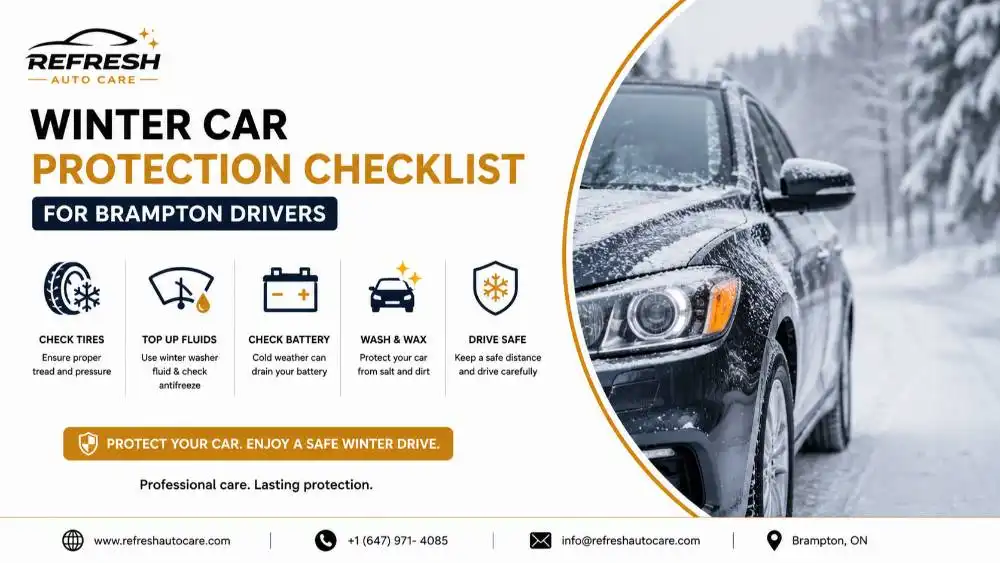
Winter Car Protection Checklist for Brampton Drivers
09-Oct-2026
How can you protect your car from a Brampton winter?
The best winter car protection strategy for Brampton drivers combines regular salt removal, proper winter tires, mechanical maintenance, paint protection where appropriate, interior protection, and post-winter inspection.
What should I do before winter?
Before winter, wash and decontaminate the vehicle, inspect the paint and underbody, install winter tires, and consider PPF or ceramic coating based on the type of protection you need. During winter, wash away salt regularly and clean the wheel wells and underbody. After winter, remove remaining salt and contaminants and inspect for chips, corrosion, and other damage.
Do I need PPF or ceramic coating for winter?
PPF is primarily for physical impact protection such as stone chips, while ceramic coating is mainly useful for hydrophobicity, easier maintenance, and resistance to environmental contamination. Neither replaces winter tires, mechanical maintenance, or regular salt removal.
Why Trust This Guide?
| Trust Signal | Details |
|---|---|
| Updated for 2026 | Latest winter protection techniques and product technologies |
| Local Expertise | Based on Brampton & GTA winter driving conditions, including road salt and weather patterns |
| Industry References | Transport Canada winter tire guidance, AAA road salt recommendations, System X Ceramic Coatings, 3M PPF guidelines |
| Real Customer Feedback | Insights from verified users and professional detailers |
| Review Methodology | Transparent rating system explained below |
This guide is based on real customer experiences, professional detailing standards, Transport Canada recommendations, and service evaluations from leading vehicle protection providers in Brampton. Each aspect has been assessed for quality, reliability, and value. Ratings are indicative summaries based on publicly available reviews and may change over time.
Last Reviewed: July 2026
How We Rated These Winter Protection Services
| Factor | Weight |
|---|---|
| Quality of Protection Products (PPF/Ceramic) | 25% |
| Installation & Application Quality | 25% |
| Customer Reviews & Reputation | 20% |
| Comprehensive Service Offerings | 15% |
| Warranty & Aftercare Support | 10% |
| Convenience (Pickup/Delivery) | 5% |
These ratings are derived from publicly available customer feedback, service evaluations, and industry standards. Scores may vary as services evolve.
Introduction
Brampton winters are not for the faint of heart. Between November and March, your vehicle faces a relentless assault of road salt, gravel, freezing temperatures, ice, and abrasive slush. These conditions can damage your paint, undercarriage, tires, and interior — and if left unchecked, they can significantly reduce your vehicle's lifespan and resale value.
But with the right preparation and ongoing care, you can protect your vehicle through even the harshest winter months. This comprehensive winter car protection checklist covers everything Brampton drivers need to know — from pre-winter preparation and ongoing maintenance to post-winter restoration and protection options like PPF and ceramic coating.
According to Transport Canada, winter tires can improve braking and handling in cold weather, making them one of the most important winter safety measures. Meanwhile, the Ontario Ministry of Transportation reports that road salt is used extensively across the province, making regular washing and underbody cleaning essential for vehicle longevity.
Who Should Use Professional Winter Protection Services?
Professional winter protection services are recommended for:
- Daily Commuters – Protect your vehicle from constant road salt and debris exposure.
- Highway Drivers – Shield vulnerable paint from stone chips and gravel.
- Luxury & New Vehicle Owners – Preserve paint, interior, and resale value.
- Families – Keep interiors clean and protect children from salt and moisture.
- EV Owners – Protect underbody components and charging ports from salt and moisture.
- Anyone Planning to Sell Their Vehicle – Maintain appearance and maximize resale value.
Brampton Winter Car Protection Checklist
Before Winter
- □ Install four winter tires
- □ Check tire pressure and tread depth
- □ Inspect brakes and battery
- □ Check coolant and winter washer fluid
- □ Test wipers, heater, and defroster
- □ Wash and decontaminate the exterior
- □ Inspect paint for chips and scratches
- □ Apply PPF or ceramic coating if appropriate
- □ Install all-weather floor mats
- □ Prepare an emergency kit
During Winter
- □ Remove road salt regularly
- □ Wash wheel wells and underbody
- □ Check tire pressure regularly
- □ Remove snow and ice safely
- □ Clean salt from interior mats and carpets
- □ Monitor warning lights and braking performance
After Winter
- □ Wash the underbody
- □ Decontaminate the paint
- □ Inspect PPF/coating
- □ Check for chips and corrosion
- □ Deep-clean the interior
- □ Assess paint-correction needs
- □ Switch to appropriate seasonal tires when conditions permit
If You Only Do 5 Things Before a Brampton Winter
- Install proper winter tires before sustained cold and snow.
- Inspect the battery, brakes, fluids, wipers, and defroster.
- Wash and decontaminate the vehicle before winter exposure.
- Protect vulnerable paint with PPF or ceramic coating based on your needs.
- Plan regular winter washes that include the underbody and wheel wells.
Why Brampton Winters Are Tough on Vehicles
Brampton winters bring a combination of challenges that can accelerate wear and tear on your vehicle:
| Winter Hazard | Impact on Your Vehicle |
|---|---|
| Road Salt | Accelerates corrosion around exposed metal and underbody components and can contribute to surface contamination and paint deterioration when left on the vehicle |
| Gravel and Sand | Causes stone chips, scratches, and pitting on paint and windshield |
| Freezing Temperatures | Drains batteries, thickens fluids, stresses engine components |
| Ice and Snow | Can freeze wipers, obstruct visibility, and place stress on exterior seals and trim; moisture entering the cabin can contribute to dampness and odours if not addressed |
| Abrasive Slush | Contains salt, grit, and road debris that can contribute to surface scratching and contamination |
Road salt and brine collect in wheel arches, behind mud flaps, and along underbody seams. If left unchecked, salt can accelerate corrosion, particularly around exposed metal and underbody components.
The good news is that with the right preparation and ongoing care, you can significantly reduce winter damage.
Phase 1: Pre-Winter Preparation (Before the First Snowfall)
1. Clean and Inspect Your Vehicle Before Winter
A pre-winter detail removes existing contamination and gives you a clean surface for applying or maintaining paint protection before regular salt and road-debris exposure begins. A professional detail is optional, but a thorough wash, decontamination, and paint inspection can give you a clean starting point before winter exposure.
A professional detail includes:
- Exterior wash and decontamination to remove bonded contaminants like iron particles, tar, and tree sap
- Paint inspection to identify existing scratches, chips, or damage that need attention
- Interior deep clean to remove dirt, stains, and odours before they get trapped by winter moisture
For Brampton drivers, professional car detailing in Brampton provides thorough pre-winter preparation that sets the foundation for all other protection measures.
2. Apply Professional Paint Protection
If paint protection is a priority, consider the type of exposure your vehicle experiences before choosing a protection system.
Ceramic Coating
Ceramic coating is a liquid coating designed to form a durable protective layer over a vehicle's paint. Professional coatings can chemically interact with and bond to the prepared clear-coat surface, creating a hydrophobic finish that makes routine cleaning easier and helps resist environmental contamination.
Refresh Auto Care offers System X ceramic coating options with certified installers. System X Pro+™ is a semi-permanent, ultra-hydrophobic 9H coating designed to provide up to 6 years of protection when installed and maintained according to applicable requirements. System X Diamond SS is a permanent 9H+ ceramic coating designed for high gloss, slickness, hydrophobicity, and long-term environmental protection. Element 119 states that Diamond SS can protect new cars for the lifetime of the vehicle and used cars for up to 8 years, depending on application and conditions.
Paint Protection Film (PPF)
PPF is a transparent protective film applied to painted vehicle surfaces. Many premium PPF products feature self-healing properties that can reduce the appearance of certain minor surface scratches. It provides strong physical protection against:
- Stone chips and road debris
- Minor scratches and abrasions
- Bug impacts
- Surface wear caused by winter road debris
For Brampton drivers who frequently drive on highways or gravel roads, paint protection film in Brampton provides strong physical protection against winter road debris and stone chips.
Why Professional Application Matters
Professional installation focuses on surface preparation, accurate application, and finishing around edges and contours. Paint decontamination removes bonded contaminants that can prevent proper adhesion.
If you prefer not to arrange your own drop-off, ask about pickup and delivery detailing in Brampton.
When Should You Delay PPF or Ceramic Coating?
Paint protection should generally be delayed if the vehicle has unresolved paint defects, fresh bodywork, significant contamination, or other surface issues that need correction first. PPF and ceramic coating are only as effective as the surface preparation and installation beneath them.
Before applying protection:
- Repair damaged paint
- Remove contamination
- Correct paint if necessary
- Allow fresh paint/bodywork to cure according to manufacturer's or repairer's instructions
- Then apply protection
3. Install Winter Tires
Winter tires are strongly recommended for Brampton drivers who regularly drive in cold, snow, and icy conditions. Transport Canada recommends using winter tires on all wheels for driving in cold, snowy, or icy conditions.
When Should You Install Winter Tires in Brampton?
Install winter tires before sustained winter conditions arrive, particularly as temperatures consistently approach 7°C and below. At temperatures below 7°C, all-season and summer tires begin to lose elasticity, leading to less traction. Winter tires keep their elasticity and grip at much lower temperatures.
What to Check:
- Install winter tires before sustained cold-weather conditions arrive
- Check tread depth regularly — Transport Canada advises against using tires worn close to or below 4 mm (5/32) tread depth on snow-covered roads and advises not to use tires that have less than 4 mm tread depth
- Check tire pressure often, especially before highway driving or longer trips, and check when tires are cold
- All tires that meet Transport Canada's winter performance requirements are marked with the "Three-Peak Mountain Snowflake Symbol" on the sidewall
External Resource: Transport Canada's winter tire guidance
4. Check and Replace Fluids
Winter demands special attention to your vehicle's fluids.
Essential Winter Fluids:
- Windshield washer fluid: Use winter-rated fluid that resists freezing down to -40°C and carry an extra jug in the vehicle
- Coolant/antifreeze: Ensure proper mixture for low temperatures
- Engine oil: Follow the manufacturer's recommended engine-oil viscosity and service interval
- Brake fluid: Test levels and condition
Transport Canada's winter vehicle guidance also recommends checking brakes, coolant, wipers, heating, and defrost systems.
5. Inspect Your Battery
Cold weather can significantly reduce a battery's available starting performance, which is why testing battery condition before winter is worthwhile. If the battery is several years old, have it tested before winter rather than relying on age alone.
What to Check:
- Battery age and condition
- Corrosion on terminals
- Charge level and cold-cranking amps
6. Make Sure You Can See and Defrost Clearly
Ensure your heater, defroster, and rear window defogger are working properly. You don't want to discover these aren't working on a freezing Brampton morning.
7. Replace Wiper Blades
Winter conditions are hard on wiper blades. Replace them if they're streaking or skipping. Consider winter-specific blades designed to handle ice and snow.
8. Install Weather-Resistant Floor Mats
Salt, slush, and moisture can stain carpets and contribute to lingering dampness and odours if they are not removed regularly. Install rubber or all-weather floor mats to protect your interior. Clean them regularly to prevent salt buildup.
9. Pack a Winter Emergency Kit
Keep a small winter emergency kit in the vehicle, especially if you regularly commute during snow or freezing conditions.
Essentials:
- Warm blanket, gloves, and spare hat
- Small shovel and sand or kitty litter for traction
- Booster cables and power bank
- Ice scraper and snow brush
- Flashlight with spare batteries
- Non-perishable food and water
- Reflective safety triangles or other roadside warning devices
Phase 2: Ongoing Winter Maintenance
10. Wash Your Vehicle Regularly
This is one of the most important things you can do during winter. Road salt and salty moisture can accelerate corrosion on exposed or vulnerable metal components. Salt and grit can also contribute to surface contamination and abrasion when allowed to remain on the vehicle.
Washing Tips:
- Wash regularly during periods of road-salt exposure. Every two weeks can be a practical baseline during normal winter conditions, but wash sooner after driving on heavily salted roads or when visible salt and grime accumulate
- Prioritize the undercarriage — use car washes with underbody sprays
- Rinse first — flush off loose salt before washing to protect the paint
- If the vehicle does not have ceramic coating or another paint-protection product, a suitable wax or sealant may provide an additional temporary barrier against contamination
- Use a touchless car wash or professional hand wash to avoid swirl marks
External Resource: AAA's winter road salt guidance
For Brampton drivers, professional paint decontamination services can remove embedded salt and contaminants that regular washing misses.
11. Remove Snow and Ice Carefully
Never use hot water to remove ice—it can crack your windshield. Use a plastic ice scraper and avoid scraping aggressively.
Tips:
- Clear all snow from windows, roof, hood, and lights
- Use a windshield cover to prevent ice buildup
- Keep an emergency kit in the vehicle and make sure your phone, charging cable/power bank, and roadside-assistance information are accessible
12. Protect Your Interior
Salt and moisture can damage your interior if not addressed promptly.
Interior Protection:
- Use rubber floor mats and clean them regularly
- Wipe down door sills and pedals to remove salt
- Vacuum frequently to prevent salt from grinding into carpets
- Consider professional interior detailing mid-winter to remove salt and moisture buildup
Professional interior detailing in Brampton can help maintain your vehicle's interior throughout the winter months.
13. Check Tire Pressure Monthly
Cold weather reduces tire pressure. Check your tires regularly, especially before highway driving or longer trips, and check when the tires are cold.
14. Watch for Warning Signs
During winter, be alert for:
- Dashboard warning lights (battery, check engine, low tire pressure)
- Unusual noises (squealing belts, grinding brakes)
- Reduced visibility (fogging, streaking wipers)
- Changes in handling or braking
Phase 3: Post-Winter Restoration (Spring)
15. Schedule Spring Detailing
After winter ends, give your vehicle a thorough detail to remove salt residue and restore its appearance. One final vehicle and undercarriage wash before spring is recommended to remove any salt deposits left over from the winter season.
Spring Detailing Includes:
- Undercarriage wash to remove salt and debris
- Paint decontamination to remove embedded contaminants
- Paint correction to address winter-induced swirl marks and scratches
- Interior deep clean to remove salt stains and odours
- Reapplication of protection if needed
Refresh Auto Care offers paint correction in Brampton to restore your vehicle's finish after winter wear.
16. Inspect for Winter Damage
What to Check:
- Paint chips and scratches — inspect exposed paint chips promptly and have bare-metal damage repaired to reduce the risk of corrosion
- Rust spots on undercarriage, wheel wells, and lower body panels
- Windshield cracks or chips
- Wiper blade condition
- Battery and fluid levels
Ceramic Coating vs PPF for Winter: Which Is Better?
Neither is universally better. PPF is better for protecting paint from stone chips, gravel, and road debris, while ceramic coating is better for water repellency, easier cleaning, and resistance to environmental contamination. For drivers who want both types of protection, PPF can be applied to high-impact areas and ceramic coating can be applied to the remaining painted surfaces.
| Protection | Ceramic Coating | PPF |
|---|---|---|
| Road salt | Helps make the painted surface easier to clean | Adds a physical film layer but does not replace salt removal |
| Water repellency | Strong | Good |
| Stone chips | Limited | Strong |
| Road debris | Limited | Strong |
| Minor scratches | Limited | Some films offer self-healing |
| UV exposure | Yes | Can help protect covered paint |
| Easy maintenance | Excellent | Good |
| Best use | Easier maintenance & environmental resistance | Impact-prone painted areas |
For Brampton drivers, PPF is the stronger choice for protecting high-impact areas from stone chips and road debris, while ceramic coating is better suited to hydrophobicity, easier maintenance, and environmental protection across painted surfaces. Some owners combine both: PPF provides physical protection against stone chips and road debris, while ceramic coating improves hydrophobicity and makes routine cleaning easier. Regular salt removal is still necessary.
What Ceramic Coating Does Not Do
Ceramic coating is not a replacement for:
- PPF against stone chips
- Proper winter tires
- Mechanical maintenance
- Regular washing
- Paint repair
- Undercarriage cleaning
What PPF Does Not Replace
PPF does not replace:
- Winter tires
- Routine washing
- Mechanical maintenance
- Salt removal
- Proper winter driving
- Repair of existing mechanical problems
PPF protects the painted surface it covers; it does not protect exposed underbody components, suspension parts, brake components, or other areas from corrosion caused by salt exposure.
What Does PPF Protect Against in Winter?
PPF can help protect vulnerable painted areas from:
- Stone chips
- Gravel
- Road debris
- Minor surface scratches
- Bug impacts
- Surface wear caused by winter road debris
PPF does not protect against:
- Major collisions
- Deep dents
- Mechanical damage
- Tire damage
- Corrosion caused by neglected underbody maintenance
PPF Winter Care After Installation
If PPF has recently been installed:
- Follow the installer's recommended curing period before washing
- For 3M PPF, hand washing can begin as early as 72 hours after installation
- 3M advises avoiding spray washing during the first 7 days
- Avoid directing high-pressure water at PPF edges or seams. 3M advises against using high-pressure wash nozzles with pressures of 4-5 bar directly aimed at and around the edges, as this may cause delamination
- Prefer hand washing or a touchless wash; brush washes can dull and scratch the film
- Remove road salt, tar, bugs, and bird droppings promptly. Bird droppings and insect debris may cause staining on the PPF coating and should be washed off immediately
- Inspect the film occasionally for edge lifting or damage. Road debris and stone chips can damage the film, so regular inspection is recommended
Quick Winter Protection Decision Guide
- Concerned mainly about stone chips? → Choose PPF for high-impact areas.
- Concerned mainly about easier washing and salt contamination? → Consider ceramic coating.
- Drive highways frequently in winter? → Prioritize PPF on exposed areas.
- Want easier maintenance across the whole vehicle? → Consider ceramic coating.
- Want both physical and environmental protection? → Consider PPF + ceramic coating.
- Paint already has scratches or contamination? → Correct and decontaminate the surface before protection.
Which Winter Protection Does Your Car Need?
| Your Situation | Recommended Protection |
|---|---|
| New vehicle | PPF, ceramic coating, or both depending on protection priorities |
| Highway commuter | PPF for high-impact areas |
| Frequent winter driving | Regular washing + ceramic coating; add PPF for stone-chip exposure |
| Luxury vehicle | PPF for high-impact areas + ceramic coating for easier maintenance |
| Older vehicle with neglected paint | Detailing + decontamination + paint correction |
| Interior affected by salt and slush | Interior detailing + all-weather mats |
| EV used throughout winter | Winter tires + regular underbody cleaning + routine vehicle checks |
Winter Car Care Mistakes to Avoid
- Don't scrape ice with metal tools.
- Don't pour boiling water over frozen glass.
- Don't leave road salt on the vehicle for extended periods.
- Don't use household detergents on automotive paint.
- Don't wash freshly installed PPF until the installer-recommended cure period has passed. For 3M PPF, the manufacturer recommends waiting at least 72 hours before washing and avoiding spray washing within the first 7 days.
- Don't ignore chips that expose bare metal.
- Don't use winter tires with insufficient tread.
- Don't assume ceramic coating prevents stone chips.
- Don't use aggressive chemicals on PPF or coated surfaces.
Can You Wash a Car When It's Below Freezing?
Yes, you can wash a car below freezing, provided you can dry water from vulnerable areas afterward. After washing, dry door jambs, handles, mirrors, seals, and other areas where trapped water could freeze. Avoid washing if conditions make safe drying impossible.
Is a Touchless Car Wash Better for Winter Car Care?
A touchless wash can reduce the risk of brush-induced surface marks, while the most important winter-care feature is effective removal of salt from the vehicle's exterior, wheel wells, and underbody. A professional hand wash is another option when appropriate.
Should I Wash My Car After a Snowstorm in Brampton?
Yes, if the vehicle has accumulated road salt, brine, or gritty slush. A winter wash is particularly useful after driving on heavily treated roads. Prioritize rinsing the lower body, wheel wells, and underbody to remove salt and abrasive debris.
Does Road Salt Damage Car Paint?
Road salt can contribute to surface contamination and corrosion when salty moisture remains on exposed metal or vulnerable areas for extended periods. Regular washing and underbody rinsing help reduce salt accumulation. Paint protection such as ceramic coating or PPF can provide additional surface benefits, but neither eliminates the need for washing.
Are Winter Tires Mandatory in Brampton?
Winter tires are not generally mandatory across Ontario, including Brampton, but they are strongly recommended for cold, snowy, and icy conditions. Transport Canada recommends using winter tires on all four wheels because they provide better traction in winter conditions.
When Should I Put Winter Tires on in Brampton?
Install winter tires before sustained cold-weather conditions arrive. Transport Canada notes that all-season and summer tires begin losing elasticity below 7°C, while winter tires retain their flexibility at lower temperatures.
How to Choose a Winter Detailing Provider in Brampton
When evaluating professional winter detailing providers, consider these factors:
- Experience and Training — Look for certified installers with documented training from product manufacturers
- Product Quality — Ask which specific films or coatings they use and verify manufacturer warranties
- Installation Environment — Professional installations require clean, controlled environments
- Preparation Process — Ask about their decontamination and paint correction procedures
- Warranty — Review manufacturer and installer warranties
- Reviews and Portfolio — Check previous work and customer feedback
For Brampton residents, Refresh Auto Care provides professional detailing, ceramic coating, paint protection film, and vehicle protection services.
Expert Tip
When it comes to winter protection, consistency matters more than perfection. A vehicle that gets regular washes, prompt salt removal, and proper winter tires will fare better than one with ceramic coating but neglected maintenance. Also, remember that ceramic coating and PPF are not quick fixes for existing paint defects—these protection services are best applied after proper paint correction to lock in a flawless finish. If your paint already has chips or scratches, have them repaired before winter to prevent salt from penetrating and causing rust.
Reviewed By
Automotive protection specialists with practical experience in winter car care, ceramic coating, paint protection film, and detailing. This content is reviewed periodically to reflect current best practices and product information.
Frequently Asked Questions (FAQs)
1. How often should I wash my car during winter in Brampton?
During periods of heavy road-salt use, aim to wash the vehicle regularly — at least every two weeks, and more often after driving on heavily salted roads. Pay special attention to the undercarriage, wheel wells, and lower body panels where salt accumulates.
2. Is ceramic coating good for protecting a car during Canadian winters?
Yes. Ceramic coating can be useful during Canadian winter because its hydrophobic surface makes the vehicle easier to clean and helps protect the paint from environmental contaminants and UV exposure. However, ceramic coating does not provide the same stone-chip protection as PPF.
3. Is paint protection film (PPF) worth it for winter driving?
PPF can be worthwhile for winter driving when your main concern is stone chips, gravel, and road debris. It provides a physical protective layer over painted surfaces, making it particularly useful on high-impact areas such as the front bumper, hood, and mirror caps. Road debris and stone chips can damage the film, so regular inspection is recommended.
4. How does winter affect my car's paint?
Winter exposes your car to road salt, gravel, freezing temperatures, and abrasive slush. Gravel and road debris can cause chips and scratches, while salt and salty moisture can accelerate corrosion around exposed metal and underbody components.
5. What is the best way to protect car paint from road salt?
The best approach is to combine regular salt removal with an appropriate paint-protection system. Wash the vehicle regularly during periods of heavy salt use, rinse the underbody and wheel wells, and consider ceramic coating for easier cleaning or PPF for physical protection against stone chips and road debris. Paint protection does not eliminate the need for regular washing.
6. How do I protect my car from road salt in Brampton?
Protect your car from road salt by washing it regularly during winter, paying particular attention to the underbody, wheel wells, and lower body panels. Before winter, clean and protect the paint, and during the season remove salt before it remains on the vehicle for extended periods. All-weather mats can also help prevent salt and slush from soaking into the interior.
7. Can I get my car detailed in winter?
Absolutely. Professional detailing services operate year-round, including in Brampton's winter conditions. Indoor facilities allow for proper detailing regardless of outside temperature.
8. How do I remove salt stains from my car's interior?
For salt stains, use a cleaner appropriate for the specific interior material and follow the vehicle or product manufacturer's care instructions. Fabric carpets may require different treatment from leather, vinyl, or Alcantara surfaces. For persistent stains, professional interior detailing is recommended.
9. What should I do if my paint has winter damage?
Schedule a professional inspection. Minor scratches and swirl marks can often be addressed with paint correction. Stone chips should be assessed and repaired promptly to reduce the risk of corrosion. For severe damage, professional paint correction and protection may be needed.
10. How long does ceramic coating last?
Refresh Auto Care offers System X ceramic coating options with different durability profiles. System X Pro+™ provides up to 6 years of protection. System X Diamond SS is a permanent 9H+ ceramic coating that can protect new cars for the lifetime of the vehicle and used cars for up to 8 years, depending on application and conditions. Actual durability depends on the product selected, installation, maintenance, environmental exposure, and applicable warranty terms.
11. Is paint protection film self-healing?
Some self-healing PPF can reduce the appearance of certain minor surface scratches when exposed to appropriate heat, depending on the film. This is particularly useful for winter driving when minor abrasions are common.
12. What should I check after winter?
After winter, wash the underbody, decontaminate the paint, inspect for chips and corrosion, check wipers, deep-clean the interior, assess paint correction needs, inspect PPF/coating, and change back to appropriate seasonal tires when conditions permit.
13. Should I get PPF before winter?
PPF can be a good choice before winter if your main concern is stone chips, gravel, and road debris. It provides a physical protective layer over vulnerable painted areas and can reduce stone-chip and minor abrasion damage. It still needs regular cleaning and proper maintenance during winter.
14. What areas of a car should have PPF for winter driving?
The most vulnerable areas include the front bumper, hood, fenders, mirror caps, and rocker panels. These areas are most exposed to stone chips, gravel, and road debris kicked up during winter driving.
15. Can winter road salt damage an EV?
EV battery packs and associated high-voltage components are commonly integrated into the vehicle's underbody structure. Follow the manufacturer's guidance for inspection and cleaning during periods of heavy road-salt exposure.
16. Does Refresh Auto Care offer winter protection services?
Yes. Refresh Auto Care provides professional ceramic coating, paint protection film, detailing, and vehicle protection services in Brampton. The team can assess your vehicle's condition and recommend the appropriate winter protection strategy.
Conclusion
Brampton winter car protection starts with the basics: proper winter tires, regular salt removal, safe snow and ice removal, and routine vehicle checks. If protecting the paint is a priority, PPF can help defend high-impact areas from stone chips and road debris, while ceramic coating can make the exterior easier to maintain and clean.
Preparing the vehicle before winter and inspecting it again in spring can help identify contamination, chips, and other damage before they become larger problems.
Need winter paint protection in Brampton? Refresh Auto Care offers professional ceramic coating, PPF, and detailing services to help prepare vehicles for winter conditions.
Book a Winter Protection Assessment or Explore Vehicle Protection Packages from Refresh Auto Care to determine which approach fits your driving conditions.