



DIY vs Professional Headlight Restoration: Which Is Better for Your Car?
04-Sep-2026
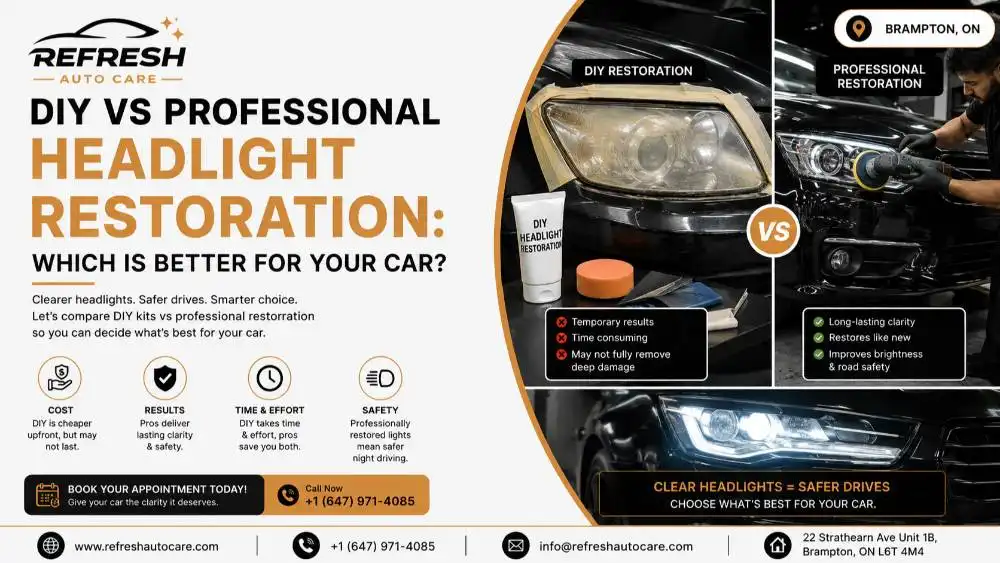
DIY headlight restoration is best suited to light exterior oxidation on a structurally sound lens. Professional headlight restoration is generally the better option for moderate or severe oxidation, extensive surface damage, pitting, previous failed DIY work, or when consistent optical clarity and durable UV protection are priorities. Cracks, internal moisture, damaged projectors, failed LED modules, or other lighting faults require diagnosis rather than simple lens restoration.
If you're dealing with cloudy, yellow, or hazy headlights, this guide will help you decide whether to tackle the job yourself or leave it to the professionals.
Why Trust This Guide?
| Trust Signal | Details |
|---|---|
| Updated for 2026 | Latest restoration techniques and AAA research data |
| Industry Research | References to AAA Headlamp Lens Deterioration Study, IIHS research |
| Technical Expertise | Based on professional restoration techniques and best practices |
| Local Market Focus | Brampton, Ontario, and GTA context |
| Actionable Insights | Checklists, decision guides, and practical guidance |
This guide is based on industry research, technical expertise, and practical experience in professional headlight restoration.
DIY vs Professional Headlight Restoration — Which Is Better?
DIY headlight restoration can be suitable for light exterior oxidation when the lens is structurally sound and the vehicle owner is comfortable following the restoration process carefully. Professional restoration is generally the better choice when oxidation is moderate to severe, surface damage is extensive, consistent optical clarity matters, or a more durable protective finish is required.
There is no universal lifespan for either method. Durability depends on the lens condition, preparation, restoration technique, UV protection and environmental exposure.
The better option depends on the condition of the lens, your restoration experience, the level of surface damage and the protective finish you plan to use.
Key Takeaways
- DIY kits cost less upfront but often produce inconsistent, short-lived results.
- Professional restoration delivers more consistent clarity with proper UV protection.
- DIY results depend heavily on preparation, technique and product quality.
- Professional restoration offers more controlled preparation and finishing.
- Headlight restoration Brampton services like Refresh Auto Care use professional-grade materials and techniques.
- DIY may damage headlights if done incorrectly.
- Professional services often include warranties and UV protection that DIY kits lack.
- Car Detailing Brampton and Auto Detailing Brampton services often include headlight restoration as part of a complete vehicle refresh.
DIY or Professional Headlight Restoration: Quick Decision Guide
| Your Situation | Better Option |
|---|---|
| Light surface oxidation | DIY may be suitable |
| Moderate oxidation | Professional restoration |
| Heavy oxidation | Professional assessment |
| Fine surface scratches | DIY may be suitable if superficial; professional assessment is safer |
| Deep scratches/pitting | Professional assessment |
| Cracked lens | Repair/replacement assessment |
| Internal moisture | Diagnose the housing first |
| Previous failed DIY restoration | Professional restoration |
| You want maximum consistency | Professional restoration |
| You enjoy DIY work | DIY may be suitable |
DIY vs Professional Headlight Restoration at a Glance
| Factor | DIY Restoration | Professional Restoration |
|---|---|---|
| Initial expense | Lower | Higher |
| Time required from owner | Higher | Minimal |
| Surface preparation | Owner-dependent | Technician-controlled |
| Sanding consistency | Depends on technique | More controlled |
| Optical clarity | Depends on condition and technique | More consistent when lens is suitable |
| UV protection | Product-dependent | Professional product/application |
| Risk of uneven sanding | Higher | Lower with trained technique |
| Best suited to | Light oxidation | Moderate/heavy oxidation or complex surface damage |
| Internal moisture | Not solved by polishing | Requires diagnosis |
| Cracked lens | Not suitable | Repair/replacement assessment |
| Long-term durability | Product/application dependent | Product/application dependent |
Bottom Line
Choose DIY restoration for light exterior oxidation when the lens is structurally sound and you're comfortable with careful sanding, polishing and UV protection.
Choose professional restoration for moderate or severe oxidation, extensive surface damage, previous failed restoration, or when consistent finishing and protection are priorities.
If the lens is cracked, internally fogged or the lighting system is faulty, have the assembly diagnosed before restoring it.
How to Decide in 30 Seconds
Choose DIY if:
- The oxidation is light.
- The lens is structurally intact.
- You have time to prepare and sand carefully.
- You understand the importance of UV protection.
Choose professional restoration if:
- Oxidation is moderate or severe.
- The lens has extensive surface deterioration.
- Previous DIY work produced poor results.
- You want more consistent preparation and finishing.
- You don't want to perform the work yourself.
Choose diagnosis or replacement instead if:
- The lens is cracked.
- Moisture is trapped inside.
- The projector or reflector is damaged.
- A bulb or LED module has failed.
- The beam is incorrectly aimed.
What Is Headlight Restoration?
Headlight restoration is the process of removing oxidation, haze, and discoloration from headlight lenses to restore clarity and improve light output. Most modern vehicles use polycarbonate plastic lenses that are prone to UV damage over time. Restoration typically involves cleaning, sanding, polishing, and applying a protective UV sealant.
Why Do Headlights Become Cloudy?
The primary cause is UV exposure. Polycarbonate lenses are manufactured with a protective surface coating designed to resist UV damage and environmental wear. Over time, that coating deteriorates, allowing UV rays to oxidize the plastic underneath. The result is a yellow, hazy, or cloudy appearance that reduces light output and makes the vehicle look older.
Other contributing factors include:
- Road debris and micro-scratches
- Dirt and pollution buildup
- Moisture and condensation
- Normal wear and tear over time
What Can Headlight Restoration Fix?
- Exterior oxidation
- Yellowing
- Surface haze
- Light surface scratches
- Some surface pitting
- Degraded exterior protective coating
What Can Headlight Restoration NOT Fix?
- Cracked lenses
- Internal condensation
- Broken housings
- Failed LED modules
- Failed bulbs
- Damaged projectors
- Damaged reflectors
- Incorrect headlight alignment
What Is DIY Headlight Restoration?
DIY headlight restoration involves using a kit purchased from an auto parts store or online retailer. These kits typically include sandpaper of varying grits, a polishing compound, and a UV sealant.
How DIY Kits Work
Most DIY kits follow a similar process:
- Clean the headlight — Remove surface dirt and debris.
- Sand the lens — Use progressively finer sandpaper to remove the oxidized layer.
- Polish — Apply polishing compound to restore clarity.
- Seal — Apply a UV sealant or clear coat to protect the lens.
Pros of DIY Headlight Restoration
- Lower initial expense — Kits typically cost less than professional services.
- Convenience — You can do it at home on your own schedule.
- Satisfaction — Some drivers enjoy the hands-on experience.
Cons of DIY Headlight Restoration
- Inconsistent results — Hand-sanding creates uneven pressure, leaving high and low spots that can cause distortion.
- Protective-coating durability varies — The longevity of DIY results depends heavily on the quality and application of the protective coating.
- Time-consuming — Proper DIY restoration requires time, patience, and attention to detail.
- Risk of damage — Inexperienced users can sand too aggressively, causing permanent damage to the lens.
- Variable UV protection — Not all DIY kits include durable UV sealants.
What Is Professional Headlight Restoration?
Professional headlight restoration is performed by trained technicians using specialized equipment, professional-grade products, and proven techniques. At Refresh Auto Care, our headlight restoration Brampton service follows a multi-stage process designed to deliver consistent clarity and protection.
How Professional Restoration Works
A professional headlight restoration process commonly involves:
Step 1: Inspect the Lens
Assess oxidation, scratches, pitting, cracks and internal moisture.
Step 2: Clean and Mask
Clean the lens and protect surrounding paint and trim.
Step 3: Remove Oxidized Material
Use controlled abrasives to remove degraded surface material evenly.
Step 4: Refine the Surface
Work through finer abrasives to reduce sanding marks.
Step 5: Polish
Restore optical clarity through controlled polishing.
Step 6: Apply UV Protection
Apply a suitable UV-resistant protective coating or sealant.
Step 7: Inspect the Finished Lens
Check clarity, consistency and surrounding surfaces.
Pros of Professional Headlight Restoration
- More consistent clarity — Professional techniques produce more uniform results.
- Controlled preparation — Professionals use controlled methods to avoid damaging the lens.
- Strong UV protection — Professional-grade sealants and coatings provide durable protection.
- Expertise — Professionals know how to avoid common mistakes like uneven sanding or damaging the lens.
- Warranty — Many professional services include a warranty on their work.
- Time-saving — You drop off your vehicle and pick it up with clear headlights.
Cons of Professional Headlight Restoration
- Higher initial expense — Professional services cost more than DIY kits.
- Appointment required — You need to schedule time for the service.
DIY vs Professional: Detailed Comparison
Surface Preparation
DIY preparation is owner-dependent. The consistency of sanding depends on hand technique, which can create uneven surfaces if not done carefully.
Professional preparation is technician-controlled. Professionals use controlled methods and appropriate abrasives to achieve a more even finish.
Optical Clarity
DIY clarity depends on the condition of the lens and the owner's technique. Results can vary considerably.
Professional clarity is more consistent when the lens is suitable for restoration. Controlled techniques help achieve a more uniform finish.
UV Protection
DIY protection is product-dependent. The longevity of DIY results depends heavily on the quality and application of the protective coating.
Professional protection uses professional-grade sealants and coatings that are applied using controlled techniques for more consistent durability.
Risk of Damage
DIY carries a higher risk of uneven sanding or over-sanding, which can create permanent distortion or damage.
Professional has a lower risk of damage when performed by trained technicians using appropriate techniques.
What AAA Research Says About Deteriorated Headlights
The AAA Headlamp Lens Deterioration Study provides useful data on headlight deterioration and restoration.
AAA laboratory testing found that the deteriorated headlamps evaluated in its study averaged 22.43% of OEM low-beam output. After restoration, average output increased to 70.40% of the OEM reference value.
Important: AAA cautioned that results depend on the condition of the individual headlamp and the restoration technique used. These figures should therefore be treated as study-specific results, not a guaranteed percentage improvement for every vehicle.
AAA also found that replacement of the headlight assembly was the most effective way to restore light output to 100%. However, restoration can improve light transmission without replacing the entire assembly when the lens itself is the primary problem.
Why Headlight Visibility Matters for Nighttime Safety
Research from the Insurance Institute for Highway Safety (IIHS) links better-rated headlight visibility with lower nighttime crash rates. Vehicles with good-rated headlights had 19% fewer nighttime single-vehicle crashes and 23% fewer nighttime pedestrian crashes than vehicles with poor-rated headlights.
This research evaluates overall headlight performance rather than restoration itself, so these figures should not be interpreted as a guaranteed crash reduction from restoring a cloudy lens. However, it reinforces the importance of maintaining clear, properly functioning and correctly aimed headlights.
Ontario Headlight Requirements
Ontario's Highway Traffic Act requires front lamps to be constructed, located, arranged and adjusted so that they provide sufficient driving light to make a person or vehicle clearly discernible within 110 metres under normal atmospheric conditions on a level road.
The Act also addresses modifications that reduce the effective area of the lens or the intensity of the beam.
Headlight restoration does not automatically make a vehicle compliant with every lighting requirement. Beam alignment, lamp condition and the complete lighting assembly should be assessed when there is a safety or inspection concern.
Should You Restore or Replace Your Headlights?
| Condition | Recommended Action |
|---|---|
| Light to moderate oxidation | Restoration |
| Surface haze | Restoration |
| Light scratches | Restoration |
| Heavy oxidation | Professional assessment |
| Deep scratches/pitting | Professional assessment |
| Cracked lens | Replacement/repair assessment |
| Internal moisture | Seal/housing diagnosis |
| Failed bulb | Bulb replacement |
| Failed LED module | Component/assembly repair |
| Damaged projector/reflector | Replacement/repair assessment |
Headlight Polishing vs Headlight Restoration
Headlight polishing generally refers to the polishing/refinement stage used to improve surface clarity.
Headlight restoration is broader and may include:
- Inspection
- Cleaning
- Masking
- Controlled sanding
- Surface refinement
- Polishing
- UV protection
- Final inspection
Understanding the difference helps you know what you're actually getting with a service or kit.
Before You Restore: 10-Point Checklist
Before choosing a restoration method, ask:
- Is the damage on the outside or inside?
- Is the lens cracked?
- Is there moisture inside the housing?
- Is the surface yellow or only dirty?
- Are the scratches superficial?
- Is the beam correctly aimed?
- Is the bulb/LED module working properly?
- Has the lens already been restored before?
- Does the lens still have enough structural integrity for restoration?
- What protective coating will be applied afterward?
How to Choose a Headlight Restoration Service in Brampton
Look for a provider that:
- Inspects the lens before starting
- Distinguishes external oxidation from internal moisture
- Explains whether sanding is appropriate
- Protects surrounding paint and trim
- Uses controlled abrasive steps
- Provides a proper protective finish
- Does not promise a universal percentage increase in brightness
- Does not claim every damaged lens can be restored
- Explains when replacement is more appropriate
- Asks what protective coating will be applied after polishing
- Will recommend replacement if the lens is structurally damaged
For a complete vehicle refresh, explore our comprehensive car detailing services and luxury auto detailing packages.
Headlight Restoration in Brampton: What Local Drivers Should Consider
Drivers in Brampton and the surrounding GTA commonly deal with:
- Winter road salt and contaminants
- Gravel and road debris
- Freeze-thaw temperature changes
- Summer UV exposure
- Dirt and traffic film
- Frequent urban/highway driving
These conditions can accelerate surface contamination and wear, but the actual cause of cloudy headlights should still be identified before restoration begins.
If your headlights are showing signs of oxidation, haze, or surface damage, it's worth considering whether restoration is appropriate for your vehicle.
At Refresh Auto Care, we specialize in headlight restoration Brampton and minor auto restoration services that bring your headlights back to life.
Our headlight and minor auto restoration services include:
- Professional sanding and polishing to remove oxidation
- UV protection coating to prevent future yellowing
- Restoration of side mirrors, trims, and exterior plastics
- Integration with our full car detailing Brampton services for a complete vehicle refresh
How to Protect Restored Headlights
- Apply UV protection — Professional restoration includes a UV-blocking sealant.
- Regular cleaning — Wash headlights regularly to remove dirt and contaminants.
- Park in shade — Reduce UV exposure by parking in garages or shaded areas.
- Use protective coatings — Consider ceramic coatings or PPF for headlights. For advanced protection, ask about Paint Protection Film (PPF) for headlights which offers a durable barrier against rock chips and UV rays.
- Regular inspection — Check headlights periodically for early signs of oxidation.
For long-term protection, consider vehicle protection packages Brampton that include paint and exterior surface protection.
Why Choose Refresh Auto Care for Headlight Restoration in Brampton?
If you're searching for headlight restoration Brampton or headlight restoration near me, Refresh Auto Care provides professional headlight restoration services for lenses affected by exterior oxidation, haze and surface deterioration.
Our headlight and minor auto restoration services include:
- Professional sanding and polishing to remove oxidation
- UV protection coating to prevent future yellowing
- Restoration of side mirrors, trims, and exterior plastics
- Integration with our full car detailing Brampton services for a complete vehicle refresh
We also offer paint correction Brampton and vehicle protection packages Brampton to keep your entire vehicle looking its best.
Not Sure Whether You Need Restoration or Replacement?
A professional inspection can determine whether the problem is surface oxidation, lens damage, internal moisture or another lighting-system issue.
Contact Refresh Auto Care to book a headlight assessment.
Frequently Asked Questions (FAQs)
1. Is DIY headlight restoration worth it?
DIY headlight restoration can be worth it if your headlights have light oxidation and you're comfortable with the process. However, results are often inconsistent and may not last as long as professional restoration.
2. How long does professional headlight restoration last?
There is no universal lifespan. Durability depends on preparation, lens condition, protective product, application and environmental exposure. Professional restoration typically provides more consistent results than DIY attempts.
3. Can DIY headlight restoration damage my headlights?
Yes. Inexperienced users can sand too aggressively, creating permanent scratches or distortion that affects the beam pattern. Professional technicians have the experience and tools to remove oxidation safely.
4. What causes headlights to become cloudy?
The primary cause is UV exposure, which breaks down the protective coating on polycarbonate headlight lenses. Road debris, dirt, pollution, and moisture can also contribute.
5. Does headlight restoration improve night visibility?
Yes. Clear headlights can improve light output significantly, making night driving safer and more comfortable. AAA research found that restoration improved light output in its testing.
6. Can I restore headlights with toothpaste?
Toothpaste may produce a temporary cosmetic improvement on very minor surface contamination or oxidation, but it is not a substitute for a proper restoration process. It does not provide the controlled surface preparation or durable UV protection needed for long-term results.
7. How often should headlights be restored?
There is no fixed schedule. Restoration should be performed when you notice signs of oxidation, reduced visibility, or before a safety inspection. Professional restoration typically provides more consistent results than DIY kits.
8. Is professional headlight restoration better than replacing the headlight?
It depends on the condition of the assembly. Restoration can be appropriate when the lens is structurally sound and the main problem is exterior oxidation or surface deterioration. Replacement may be more appropriate when the lens is cracked, severely crazed, internally damaged or when another component of the lighting assembly has failed.
9. How long does DIY headlight restoration last?
There is no reliable universal lifespan for DIY headlight restoration. Durability depends on surface preparation, the extent of oxidation, the restoration method, the UV-protective product and environmental exposure. A properly prepared lens with suitable UV protection can remain clear longer than a poorly prepared lens with inadequate protection.
10. What is the difference between headlight polishing and headlight restoration?
Headlight polishing generally refers to the polishing/refinement stage used to improve surface clarity. Headlight restoration is broader and may include inspection, cleaning, masking, controlled sanding, surface refinement, polishing, UV protection and final inspection.
11. Does Refresh Auto Care offer headlight restoration in Brampton?
Yes. Refresh Auto Care offers professional headlight restoration and minor auto restoration services in Brampton and the GTA.
Conclusion
So, which is better — DIY or professional headlight restoration?
DIY: Light oxidation + willing to do the work + comfortable with the process.
Professional: Moderate/heavy oxidation + consistency + surface protection + peace of mind.
Neither: Cracked lens, internal moisture or component failure — those require diagnosis first.
If you're searching for headlight restoration Brampton or headlight restoration near me, Refresh Auto Care offers professional headlight restoration services that restore exterior clarity and improve the appearance of structurally sound lenses.
Explore Headlight Restoration in Brampton or Contact Refresh Auto Care to book your appointment today.